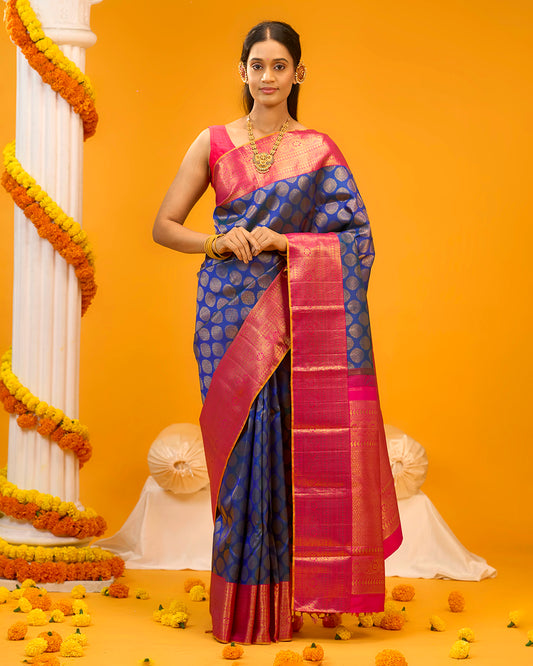
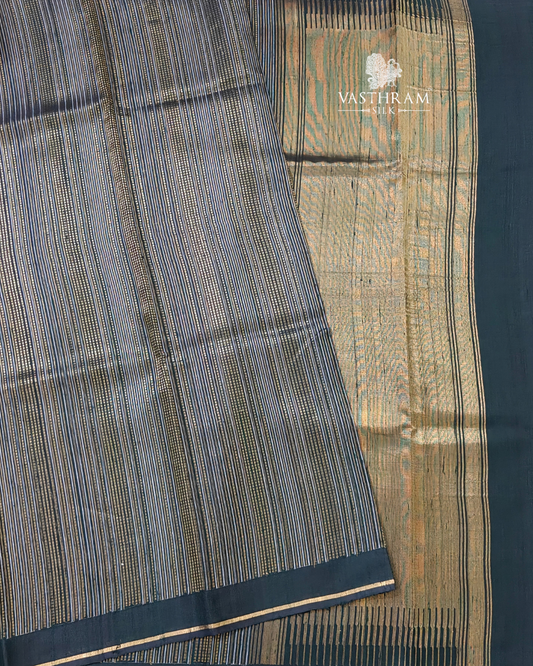
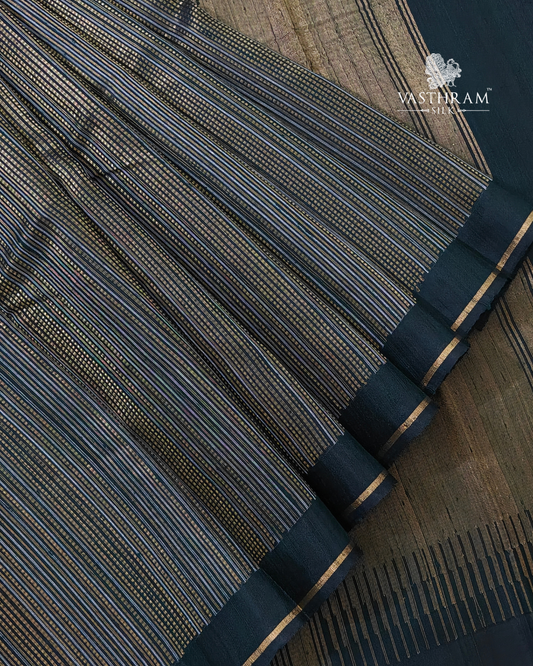

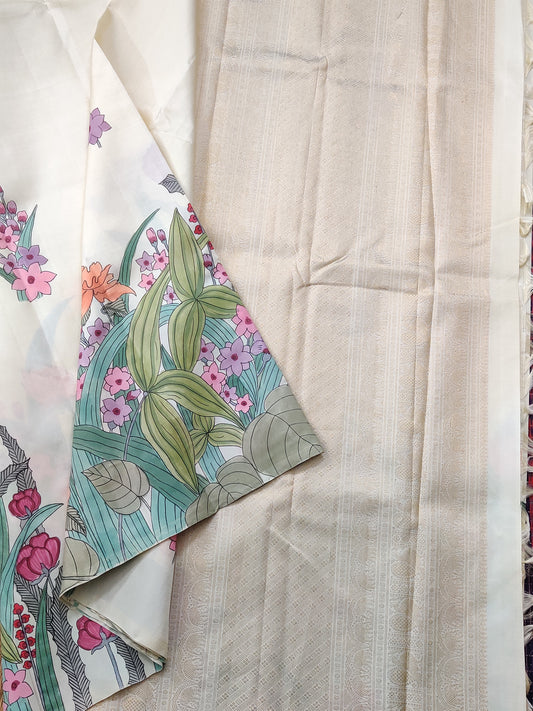




Kodalikaruppur Saree — The Thread That Remembers
T HE W O V E N M A N U S C R I P T S E R I E S
I . O P E N I N G
A Fabric That Arrived Before Language
There are textiles that clothe the body , there are textiles that clothe the soul. 
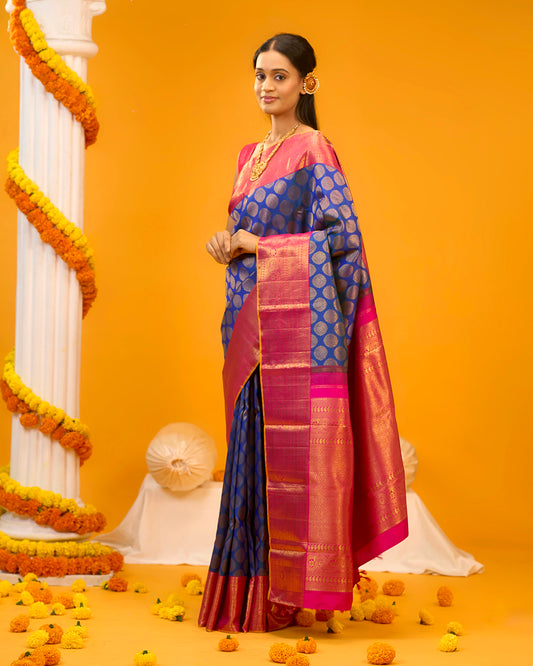
Kodalikaruppur Pure Cotton Saree
Kodalikaruppur belongs to the second kind. To hold one for the first time is to encounter something close to awe a sensation often reserved for old temples and open sea. The silk carries a quiet luminosity, its motifs reading less as decoration than as memory made visible. Produced in the village of Kodalikaruppur near Kumbakonam in the Cauvery delta, Kodalikaruppur saree this textile tradition occupies a singular place in Indian handloom heritage.
The craft survives today in only a small number of weaving families, making it one of South India’s rarer living textile traditions. Depending on intricacy, a single piece may take weeks to complete. No two are entirely alike — not as a marketing claim, but as the natural result of the human hand.
“A Kodalikaruppur saree is not made. It is negotiated — between weaver and silk, between the living tradition and the particular day’s light, between what the ancestors decreed and what the fingers remember.”
I I . H I S T O R Y & O R I G I N S
The Court Remembered What the Market Forgot
The history of Kodalikaruppur textiles is closely tied to the artistic world of Thanjavur, especially the rich cultural milieu shaped under Maratha rule. The origin of this fabric is attributed to Raja Serforji of Thanjavur (1798-1832) who announced that a contest would take place to choose a best woven saree to be given as present to his queen for her birthday.

Raja Serforji II and his wife
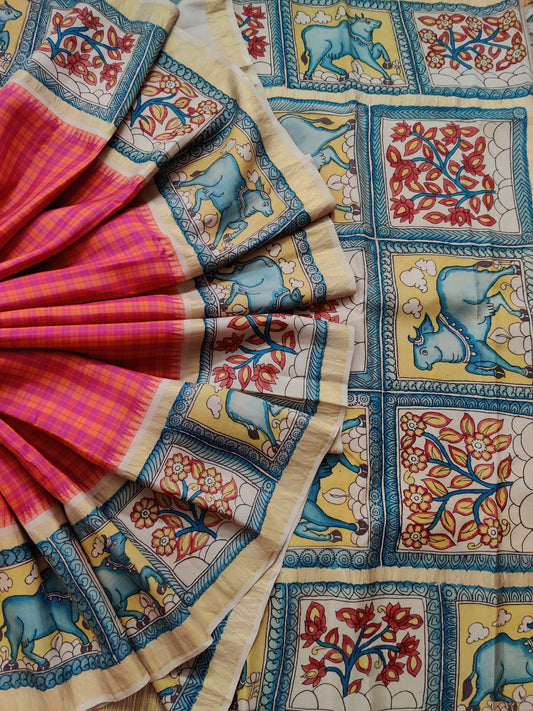
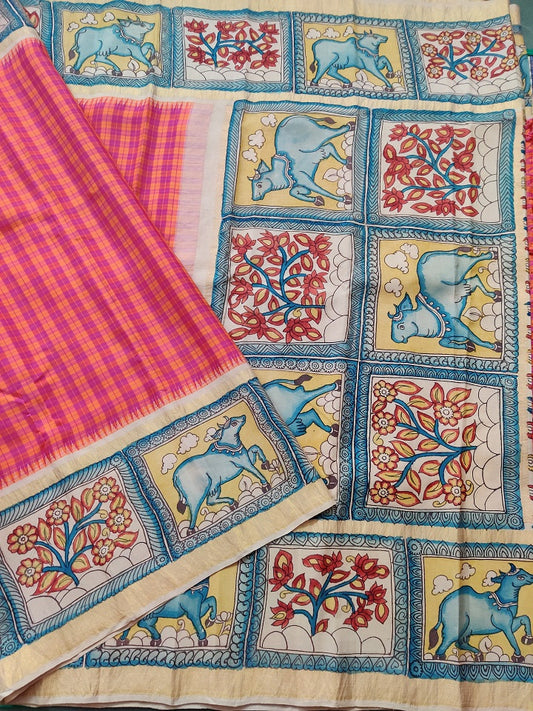
A Kavarai chettiar creates this Karuppur prototype – specific characteristic being
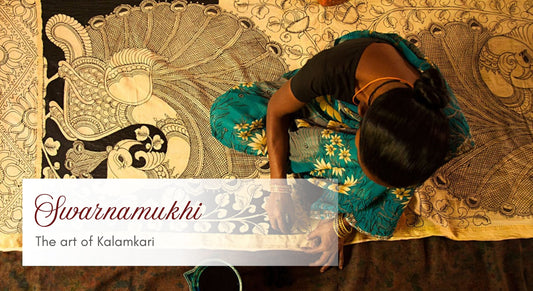
kalamkari being done on the shimmering textual quality (cotton interspersed with zari or metallic yarn) in the jamdani figures portions of the saree.While its precise evolution remains debated, the tradition is often associated with a broader ecosystem of courtly, temple, and artisanal patronage that nurtured music, painting, and craft in the region.
Some scholars and practitioners note affinities between Kodalikaruppur ornament and the visual language of Tanjore painting — in their bold motifs, rich colour fields, and devotional sensibility.With shifts in patronage during the colonial period, the tradition receded from wider visibility, surviving through hereditary weaving families and local cultural demand. That it endured at all is remarkable.
CRAFT FACT
Kodalikaruppur derives its name from the village itself, situated near the sacred Kaveri delta — a landscape so temple-dense that every direction of the compass points toward a gopuram. Scholars note that many motifs in Kodalikaruppur textiles correspond directly to the iconographic programmes of the Brihadeeswara and Airavatesvara temples.
I I I . C R A F T C H A R A C T E R I S T I C S
The Distance Between This and Everything Else
To speak of what distinguishes Kodalikaruppur textiles from other South Indian silks is to speak of a textile where weaving and surface art meet.
The Painted Surface
What distinguishes the tradition is what follows weaving: painted and resist-decorated motifs applied through painstaking manual processes. Historically these drew on natural and mineral-derived color traditions, though methods have evolved over time. The result places Kodalikaruppur in a rare category — at once woven textile and painted cloth.
DID YOU KNOW?
Unlike screen-printed or digitally processed textiles, the hand-painted surfaces of
Kodalikaruppur sarees are never perfectly repeating. Each motif bears the slight variance of the human hand — an imprecision that constitutes, for the discerning collector, the very proof of authenticity.
The palette of a traditional Kodalikaruppur is warm and earth-anchored: deep maroons, terracotta, ochre gold, lamp-black, and an ivory that suggests aged silk rather than bleached cotton. Occasionally a piece incorporates a cooler blue — indigo from the Kaveri corridor — that reads against the warm ground with an almost electric quietness.

Kodalikaruppur Chanderi Silk Cotton Saree With An Earthy Palette
I V . T H E M A K I N G
A Process Measured In Patience, Not Days
The making of a Kodalikaruppur saree cannot be reduced to a process without losing something essential. But to understand why it commands the attention it does, one must understand what the hands have done.
01 Silk Selection
Silk yarn is prepared, dyed, and readied before weaving begins — an early stage that establishes the ground of the textile.
02 Warping the Loom
The warp is set by hand, a laborious process involving thousands of threads aligned under careful tension.
03 Weaving
The silk ground is woven on handlooms at a measured pace, with the woven surface
often intentionally understated so ornament can later emerge as the focus.
04 Washing & Preparation for Painting
After weaving, the cloth is washed and prepared for surface work, ensuring the fabric can receive painted or resist decoration.
05 Motif Transfer & Painting
Traditional motifs are developed through painstaking manual processes — drawn,
painted, or resist-worked by hand, often through knowledge transmitted within artisan families.
![]() 06 Fixing & Finishing
06 Fixing & Finishing
The textile is then finished, set, and hand-folded — final stages that complete the
transformation from woven cloth into ceremonial object.


Weaver in motion Loom Process
Hands at the loom: the rhythm of Kodalikaruppur weaving produces a sound — a particular soft percussion — that weavers describe as the saree speaking before it exists.
V . V I S U A L G R A M M A R
What the Motifs Are Actually Saying
In the visual language of Kodalikaruppur, nothing is merely ornamental. Every form that appears on the surface of the cloth — whether in the body, the border, or the pallu — carries a specific semantic weight, derived from the iconographic tradition of Tanjore painting, Tamil temple sculpture, and pan-Indian mythological imagery. To wear a Kodalikaruppur is to carry text on your body.
The Peacock
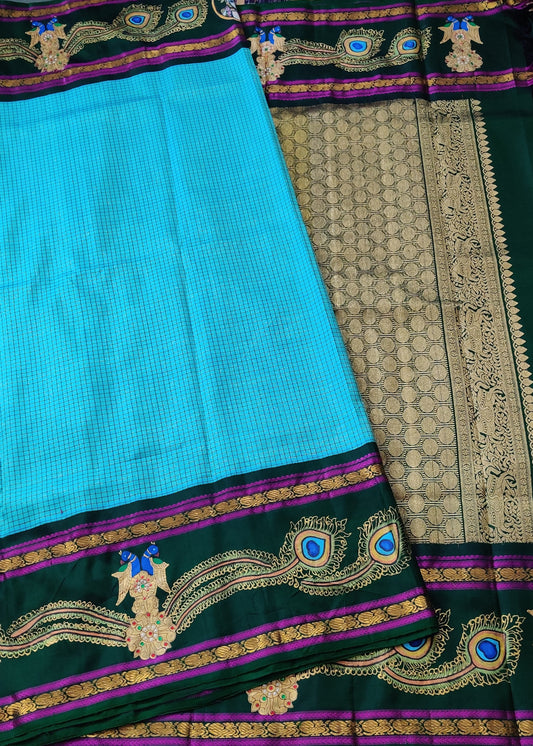
As vahana of Murugan, the Tamil war god, the peacock represents courage, divine protection, and the victory of wisdom over ignorance. Its tail feathers, rendered in elaborate detail, symbolise the expansion of consciousness — each eye a universe in itself.
Parrots
The parrot appears most frequently in the context of Kamadeva, god of love and longing. In Tamil Sangam poetry, the parrot is the messenger between lovers, carrier of secret words. On the saree, it speaks of romantic intelligence, fidelity, and the sweetness of language itself.
Temple Borders
The temple tower — the gopuram — translated into a flat textile border becomes a sequence of vertical forms that mirror the tiered architecture of South Indian temples. This border is a processional path; to wrap it around the body is to enact a circumambulation.
Lotus & Florals
The lotus, ever-present in Hindu and Buddhist iconography, signifies purity that arises from impure conditions — the divine manifesting in the material world. In Kodalikaruppur textiles, the lotus is frequently stylised into a geometric medallion form, abstract and ancient.
Mythological Forms
The most ambitious pieces carry full narrative scenes — episodes from the Ramayana, the Mahabharata, or the Puranic stories of Shiva. These require painter-level skill and weeks of additional work; they represent the highest expression of the tradition.
The Mango (Paisley)
Called manga in Tamil, the teardrop-mango form appears in borders and corner medallions as a symbol of fertility, auspiciousness, and the tropics themselves. Derived from the bent tip of a mango fruit, it is one of the oldest motifs in South Asian textile history.

Motifs used widely in kodalikaruppur Sarees
V I . C O N T E M P O R A R Y R E L E V A NC E
The Heirloom as Position
In an era when “heritage” is casually applied to almost everything, genuine heritage asks something harder: time, attention, and understanding.
Increasingly, Kodalikaruppur textiles is being appreciated not merely as clothing, but alongside objects of enduring cultural and aesthetic value. Exceptional examples can
deepen in collector interest over time, and older well-preserved pieces often develop a softness and tonal depth that many connoisseurs prize — something akin to what the French call patine.
COLLECTOR'S NOTE
With careful storage — folded in muslin, protected from light, periodically aired
— fine silk can endure for generations. Historic South Indian textiles survive in
important collections, including the Victoria and Albert Museum, reminding us
that cloth, too, can carry memory across centuries.
For the contemporary dresser who has arrived at a point of view — who has moved past the acquisitive accumulation of fast fashion into the slower, more deliberate territory of things that mean something — Kodalikaruppur offers a form of self-expression that no luxury brand can manufacture. It is worn differently, too: without the self-consciousness of the conspicuous label, with a quieter authority that comes from knowing exactly what you are wearing and why.
V I I . T H E C A S E F O R P R E S E R V A T IO N
What We Lose When a Craft Dies
When a craft tradition disappears, the usual lament concerns economic loss. That
matters. But another loss is harder to name: forms of knowledge embedded in practice begin to erode.
Kodalikaruppur textiles embodies aesthetic and cultural knowledge shaped over
generations — in motif, material, proportion, and process. Much of this can be documented, but not fully captured by archives alone. It survives most completely in
living practice.
“What survives in Kodalikaruppur is not a product. It is a position — a particular way of standing in relation to time, to matter, to beauty. We cannot afford to lose that position.”
A recurring concern voiced by weavers is not only economic precarity, but irrelevance — the fear that inherited knowledge may be judged unnecessary. The answer is not sentiment alone, but sustained patronage.
To buy a Kodalikaruppur saree from a weaver who made it himself, in a village where the tradition still lives, is a different act from buying a reproduction in a mall. It is an act of continuation. It keeps a light on in a room that has very few windows left.
I X . C L O S I N G
Wear It as if You Know What You Are Carrying
There is a Sanskrit word — vasthram — from which cloth takes its name in
several Indian languages. It derives from the root that means to clothe, to cover,
to protect. But to clothe is also to reveal: it is the cloth, more than almost anything
else, that tells the world who you believe yourself to be.
A Kodalikaruppur saree asks something unusual of its wearer. It asks her to be equal to it — to carry its history, its intention, its accumulated weight of human skill and time and devotion, without being crushed by it. This is not a burden. It is an invitation. To wear it is to enter into a conversation with every hand that shaped it, every dye that was fixed in it, every story that was painted into its surface.
The craft will not save itself. The weaver will not wait. The thread that remembers is still held between two human hands, somewhere in the Kaveri delta, where the mornings are humid and slow and the gopurams catch the first light before the rest of the world is awake.
Tags: